MyDailySuccess4 min read
Why Overthinking Won’t Fix Overthinking (And What to Do Instead)
Trying to solve overthinking with more thinking is like trying to extinguish a fire by pouring gasoline on it. When your mental engine gets stuck in a loop, the single fastest way to break the cycle is through physical action.

Have you ever found yourself lying awake at night, pacing back and forth in your room or… staring blankly at a glowing screen( that's today's problem), desperately trying to think your way out of a bad mood (sometimes you know why but you do nothing but staying inactive)?
We have all been there. When life gets overwhelming, our default human instinct is to retreat inward. We analyze every detail, ruminate on past decisions and intellectualize our emotions, naively hoping that if we just find the "right" thought pattern, everything will magically click back into place.
Except, it almost never works that way. Trying to solve overthinking with more thinking is like trying to extinguish a fire by pouring gasoline on it. A bad thoughts leads to another worse and then chaos! Bad scenarios are created and destroy the mood.
As the timeless wisdom reminds us: Your mind isn’t cleared with thought. It is cleared with movement.
We often treat the mind and body as two entirely separate entities, but in reality, they are deeply interconnected. When your mental engine gets stuck in a loop, the single fastest way to break the cycle is through physical action.
Here is an expanded, step-by-step breakdown of how to match your specific emotional state with the exact physical remedy it needs.
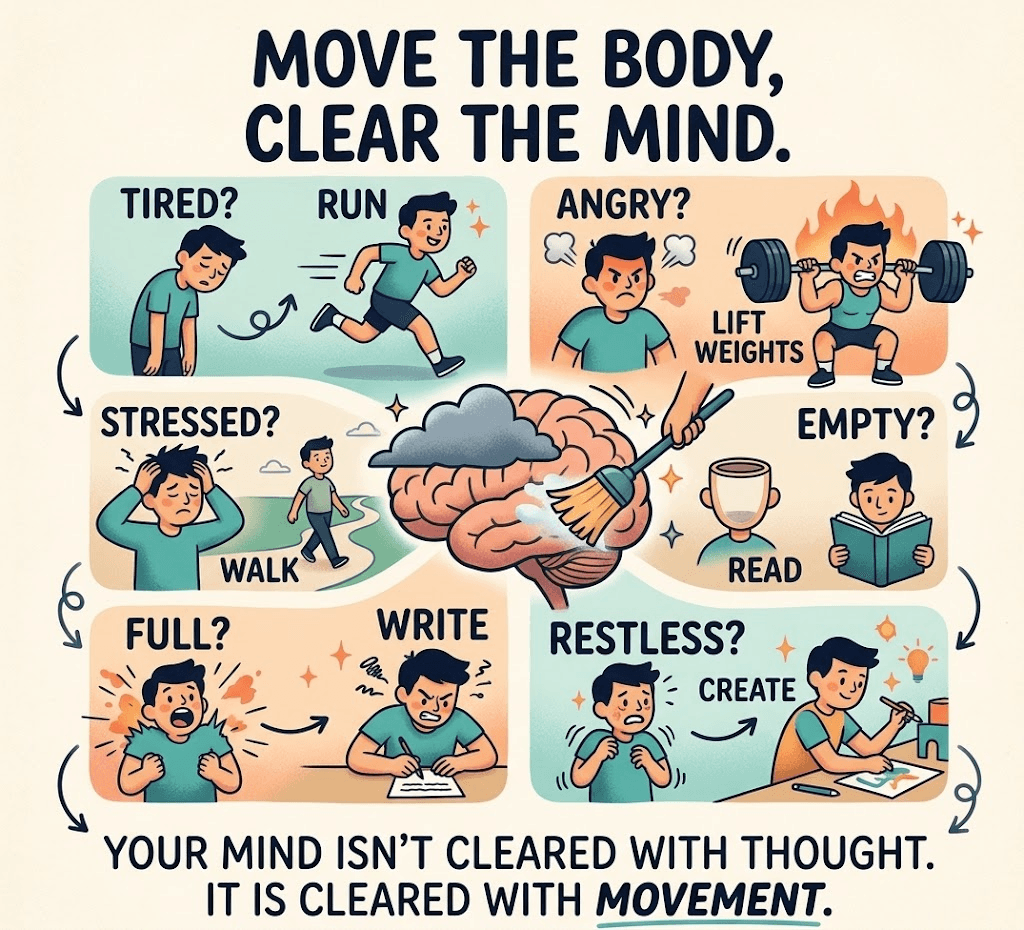
1. Tired? Run
When you feel sluggish, heavy and mentally exhausted, your immediate impulse is usually to lie down on the couch and scroll through social media. However, passive consumption under the guise of "resting" almost always leaves you feeling even more drained than before.
- The Example: Instead of melting into the couch after a long, brain-melting work day, lace up your sneakers for a 15-minute jog. You don't need to break a world record. The goal is simply to force your heart to pump fresh, oxygenated blood throughout your cardiovascular system. Physical exertion triggers a release of endorphins and dopamine that re-energizes your system far more effectively than an extra hour of screen time.
2. Angry? Lift Weights
Anger is pure, volatile, high-potency energy looking for an immediate exit. If you try to suppress it, it burns you up internally; if you vent it recklessly through words, it destroys your relationships.
- The Example: Channel that intense heat directly into resistance training. Go to the gym, pick up heavy iron, hit a punching bag or do explosive push-ups until failure. Pushing against heavy resistance gives your body a healthy, structured outlet to discharge that fight-or-flight energy safely, leaving you feeling calm, grounded and clear-headed afterward.
3. Stressed? Walk
When anxiety strikes and your thoughts are racing in chaotic circles, forcing yourself to sit still at a desk often makes you feel trapped and amplifies the panic.
- The Example: Leave your phone behind or put it on "Do Not Disturb" and head outside for a 30-minute walk in nature or around your neighborhood. As your legs move in a steady, rhythmic pattern, your nervous system naturally begins to down-regulate. The lateral eye movements that occur naturally as you scan your environment during a walk (known as optic flow) actively quiet the brain's fear centers, allowing your mind to settle down at its own natural pace.
4. Empty? Read
There are times when you feel emotionally hollow, burnt out and completely devoid of inspiration. You feel like a dry well, unable to muster up enthusiasm or creativity for anything.
- The Example: Recognize that you cannot pour from an empty cup. Stop demanding output from a brain that needs input. Grab a physical book,a rich novel, a biography or philosophy and immerse yourself in someone else's thoughts for an hour. Reading quietens your internal chatter and gently refills your mental well with fresh perspectives, vocabulary and insights.
5. Full? Write
Conversely, there are days when your brain is overflowing with too many thoughts, competing ideas, unresolved conflicts and endless to-do lists. This internal clutter creates mental paralysis because you don't know where to start.
- The Example: Practice a "brain dump." Grab a journal or a blank piece of paper and write continuously for 10 minutes without editing or censoring yourself. Spill every thought, worry and task directly onto the page. Externalizing your internal world transfers the burden off your brain and onto paper, instantly converting a chaotic emotional storm into structured, actionable clarity.
6. Restless? Create
Restlessness is latent creative energy stuck in limbo. It manifests as fidgeting, compulsive phone-checking or an uneasy feeling that you should be doing something, even if you don't know what that something is.
- The Example: Stop overthinking your options and give your hands a tangible job to do. Build something with your hands, repair a broken household item, cook a complex meal from scratch, sketch or organize a messy workspace. Directing your focus toward a physical creation anchors your sensory mind in the tangible world and dissipates restless anxiety.
The Takeaway: Change Your Body to Change Your Mind
The next time you find yourself stuck in a mental loop, don't demand that your brain solve its own mess through sheer willpower. Instead, ask yourself: What physical state shift do I need right now?
Move the body, and the mind will follow.
MyGrowth is the habit tracker we build, if you want to see how often you move instead of overthink.
Read more
The Art of the Flip: How to Turn Everyday Clutter Into Cash Without the Guesswork
The friction of reselling is real, but beating it is easier than you think. Let’s break down how to stop guessing, price like a pro and finally clear out your space.

Crafting Focused iPhone Experiences: iOS App Trends, Independent Studio Dynamics, and the Future of Mobile Software
Let's dive deep into the defining iOS app trends of 2026, backed by industry data and explore how focused software and indie studio dynamics are changing the game.

How to organise iPhone videos so you actually rewatch them
Phones made filming effortless, so camera rolls fill with clips nobody opens again. Why that happens, and how collections and loops turn a pile of video into something you watch.